Codex of the Iron Path: Tale of Boucheron
-
Height: 6'2" (188 cm)
Build: Broad-shouldered, battle-worn
Eyes: Dark brown, intense
Hair: Brown, short-cropped, silver at temples
Armor: Crimson-enameled plate, ridge-reinforced
Weapon: Bastard sword
Faith/Symbols: Red Knight/chess-symbols
Voice: Deep, calm, commanding
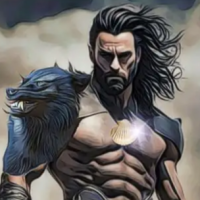
Vibe: Tactical, immovable, premeditated violenceBoucheron is a tall, broad-shouldered man in his late thirties or early forties, bearing the poise of a battlefield commander and the stillness of a chess master between moves. His presence is heavy, not with threat, but with intention. Every movement is measured, as though he’s already played out five outcomes before shifting his stance. Ruhin wears a custom-forged suit of plate of Cormyrean steel, reinforced at the shoulders and ribs with braced bastion ridges, evoking the image of fortress walls. The armor is enameled in faded crimson, the Red Knight’s color, but dulled from years of battle. Scratches and scars have not been polished away, they are annotated in his war journal with the battles where he earned them.
His bastard sword is carried in a long scabbard at an angle with a draw that requires both intention and strength. The hilt is wrapped in dull red leather, the pommel shaped like a bishop’s helm, and the blade etched with scripture in Celestial along its fuller: “Let the blade falter only when the battle is already won.”
When needed, he bears a steel heater shield, embossed with a simplified tactical square. However, he prefers to fight two-handed when not in formation. He keeps a leather-bound journal of war notes, abdstrapped to his hip is a satchel that contains maps, tactics, enemy formations, and Red Knight doctrine. He keeps a chess set made of polished stone with its pieces stored in a hidden compartment in his pack, used not for play, but for teaching and planning. Small vials of ash collected from old battlefields are kept too, and are used in rituals or blessings before combat.
Face: Weathered, angular features with a clean-shaven jaw and high cheekbones. Not handsome in the courtly sense, but strikingly composed. The left corner of his mouth bears a ragged scar, the ghost of some historical battle.
Eyes: Deep brown, intense and unblinking. Often locked onto the center mass of whoever addresses him. Never flinching, never rushed.
Expression: Calm and unreadable. His smiles are rare, and when they come, they are dry and knowing. Never cruel.
Hair: Short, military-cut brown hair dusted with silver at the temples. Neatly kept.Motivations, Lifestyle, and Faith
“Neither longsword nor greatsword, the bastard blade chooses no master but punishes all pretenders. To wield it one-handed is to court danger. To wield it two-handed is to deliver it. - Vareth the Iron-Grip, Swordmaster of the Sixth Wall
The Templar’s Path
Ruhin was no noble’s son yet his bloodline had always raised eyebrows. Raised in the shadow of Immersea’s training hall, he served as sword-bearer to the knights of the local Templar Seminary of the Triad - an order devoted to Tyr, Torm, and Ilmater. Where others were taught sword drills in marble halls, Boucheron stole glances at forms while polishing boots and listening behind oak doors.
But it was the sword that called to him - not any sword, but a bastard blade forged in ancient steel, locked in the chapel reliquary. An artifact that did not belong to any of the Triad but gifted it was said from the templars of the Red Knight. A tool to be called upon when justice would be demanded for the many instead of the few. “Faith tempers the hand,” the instructors would say. “Strength is not given, but earned on bloodied knees.”
At sixteen, Boucheron challenged the trial of arms, unheard of for one of his status. The master of blades laughed, but the High Justicar of the temple, moved by some divine flicker, allowed it. His trials would soon begin. There was always more to Ruhin, and perhaps he deserved a chance. So began the trials.
The Trial of Three Blades
Ruhin faced three opponents, each a test of a virtue:
The Crimson Devotee: A fellow student, proud and quick with a shortsword. This was the test of Temperance. Boucheron disarmed him, not with strength, but by noticing a limp and circling to his weak side.
The Penitent Giant: A half-ogre convert wielding a warhammer. The test of Compassion. Rather than finish the fight, Boucheron yielded when his blow broke the opponent’s ribs. He accepted disqualification, kneeling to offer healing.
The Mirror Knight: A conjured illusion of himself, perfectly mimicking his strikes. The test of Faith. Only by closing his eyes and trusting his instincts, and the will of the Triad, did Boucheron strike true.
The reliquary sword, untouched for decades, unlocked itself at the moment of his final strike. The priests said the Triad had spoken.
Boucheron was offered knighthood but refused. He took instead the oath of a Wandering Templar, offering sword and judgment across the lands of Cormyr. Some claim he walks the Hullack still, seeking out unjust lords and training the lowborn in secret.
Among the local youth of Immersea, a tradition endures: each year, the strongest orphan challenges the Templar Seminary for a mock duel; “For Boucheron,” they say. From then on, every year the priests would offer a blessing… a wooden sword just a bit too big for one hand.
Chapter III: On the Edge of Discipline — The Way of the Bastard Sword
The bastard sword. Often named the hand-and-a-half sword or bastard blade, demands both finesse and brutality. It is a weapon forged in contradiction: long enough for cleaving, light enough for riposte, yet too unbalanced for the untrained. Masters of this blade walk a narrow path between power and precision.
Boucheron's Technique:
“Yield no ground unless it bleeds them to take it.” - Ser Karela the Bastion
A style focused on holding the line and counter-striking with overwhelming force. Defensive, proud, unyielding. It is believed that this discipline is an ancient, brutal sword style passed down by battlefield executioners and war-priests who served in the forgotten wars of old Netheril and Thesk. It emphasizes unstoppable momentum, deliberate strikes, and bone-breaking follow-throughs that turn each blow into a moment of judgment.
“Hold the line. Break the will. Win the war.”
The Scarlet Bastion Style is a martial discipline that fuses unyielding defense with overwhelming counter-force, inspired by the divine tactics of the Red Knight. It is not a style for the reckless or the bold - it is for those who know the battlefield is a puzzle, and that victory begins not with the first blow, but with the first position.
Where most martial styles teach motion and momentum, the Scarlet Bastion teaches presence. The practitioner becomes a fortress unto themselves; a living bulwark, immovable and inevitable. Their blade is not fast, but final.
Only those with the strength to lift a heavy blade and the patience to wait for the right moment can master this discipline.
“Let them break against your position. Strike not first. Strike most.”- Doctrine of the Crimson TableauThe Scarlet Bastion Style originated during the Siege of High Horn over 300 years ago in Cormyr, when a small Red Knight-devoted garrison held off an invading mercenary army for nine full days with only two dozen trained knights and a single war-priest.
Commanded by Ser Karela the Bastion, a devout tactician-knight of the Red Knight, the defenders used tight formations, layered retreat zones, and punishing counter-assaults to break morale and momentum. The battlefield reports later became known as The Scarlet Pages, a set of illustrated war-table diagrams annotated in Karela’s hand.
From these texts, the Scarlet Bastion Style was born.
"Who taught you the blade anyway?", a friendly enough question.
"Such blades are figured out more than learnt.", the short story.