For a year after Geraldine's fall, Cormac Randolph did not return to Peltarch in any meaningful sense.
He returned to the war.
The distinction mattered.
The banners of the invasion had been broken. The great hosts had been scattered. Geraldine's defeat had given Peltarch something resembling peace, and the courts and councils were increasingly willing to speak of the invasion in the past tense.
Cormac was not. After the war he'd felt mostly useless as he always did after such things. Nobody needs a hero when the beast is slain, to the city, he'd become a mere brute again - someone to avoid. A violent man that had no place in a civilized city among civilized folk. Cormac was no longer welcome by the time the trumpets stopped singing their victorious return.
To him, the war could not end. He'd chase it, he'd hold his teeth around the throat of the thing and hold it for as long as he could until its eyes rolled back and it was done, done for good.
He told himself that it, the 'war', had merely stopped marching in formation. There were still men in black wandering the forests. A Knight's duty after all, justified.
Surely there were caches of weapons buried beneath abandoned farmhouses. Still Banite priests preaching in dark cellars. Deserters from the campaign stealing horses. Still, there were officers who had escaped with enough coin, maps, and surviving soldiers to make themselves dangerous.
So Cormac hunted them.
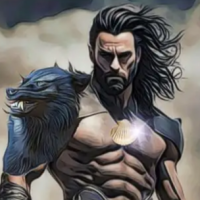
Not as a general conducting a campaign, but rather as a wolf, and the Tuigans learned to hunt with him.
Captain Arvek Thul was the first of the great survivors to understand what was happening.
He had approximately forty men when he vanished into the northern country.
Cormac never attacked him directly.
That was the lesson.
A patrol would disappear completely, no trace for days until the lost men would be found along the side of the road with their hands cupped like beggars, a closer look showing each man dead with his throat cut; they'd been posed this way. Alms, alms for the poor. At times, a supply cart would be found overturned, the riders slain and the horses gone. A messenger would arrive at a rendezvous only to discover that the men waiting for him had been killed hours before. Horses would vanish during the night. Food stores would burn.
And occasionally a rider would find a dead dog in the road, usually with its throat cut or its guts spilled and strewn about.
No formal message.
Just the eviscerated dog. Thul eventually tried moving at night.
Cormac changed his tactics and stopped pursuing Thul altogether, and instead began eliminating everything Thul needed to survive.
The captain's remaining soldiers began abandoning him.
One by one.
Cormac's Tuigans drove them away from wells, from hunting grounds and from settlements. They pushed them into barren country where the Zhents had to choose between starvation and exposure. The wilderness bore nothing close to a chance for the few remaining weary soldiers.
When Thul finally attempted to cross the frozen Narfell wastes, Cormac was waiting.
There was no battle.
The Tuigans simply surrounded the camp at dawn. Thul panicked and half blind, looked across the sun-reflecting snow and saw perhaps twenty riders. Then another twenty appeared behind them. Then another group on the ridge. Thul finally understood that Cormac had never needed to know exactly where he was going. Thul's forty-some men had dwindled, he had nothing left.
He had simply been closing every road except one.
Thul surrendered as did his remaining half-dozen or so men.
Cormac took his sword. He did not accept Thul's surrender.
The captain's head was later sent to Thalaman.
His sword went with it.
Captain Selyra Vann was harder.
She became a ghost.
For months, Cormac heard stories of a woman traveling under different names. She became a merchant, and wore a curled fake mustache, posing as man. A widow veiled in black. For a time she convinced others she was a healer, her craft made this particularly convincing. The refugee guise worked for a time. It's said that once she even traveled as a minor noblewoman.
Cormac did not find her easily. And so, he went after the people she trusted. He soon stopped killing them. That was what frightened Selyra.
Cormac's riders would often capture an informant, take away their weapons, feed them, and release them with a message. The message was always the same: "Tell Selyra that Cormac got here first. Tell her he's waiting."
Eventually Selyra realized the trap. Every person Cormac released carried the same message.
She stopped trusting everyone. That was precisely what Cormac wanted, he reveled in the psychological victory; filling Zhent hearts with fear, real fear. The final pursuit lasted eleven days.
Selyra fled south with two companions.
The Tuigans appeared behind her every morning. Never close enough to attack, far enough for her to relax. The anxiety caused her to make mistakes.
On the seventh day, she abandoned her horse - deciding it was too easy to track. On the ninth, she was separated from her companions in an ambush. On the eleventh, she entered an abandoned watchtower and discovered that the Tuigans had already searched it.
Cormac was sitting beside the cold hearth. He looked up. "Took your time."
Selyra supposedly laughed.
Then she tried to kill him.
The attempt failed, and her death was not particularly dramatic.
Cormac simply took her dagger away, catching the blade in his fist and plucking it from her without pomp or ceremony. In the end she was unable to bear her own weight and had to let go of the handle, she fell a foot or two and landed on her backside, staring up at the big barbarian dumbfounded. He turned the dagger in his hand and drove the blade like a spike down into her forehead. There was surprisingly little blood. She twitched and kicked, and expired.
The Tuigan scouts found her belongings afterward. Among them were forged letters bearing the seals of three northern settlements.
Cormac was unamused.
Her head went to Thalaman, the dagger still protruding from the skull.
Her letters went to the magistrates.
Sergeant-Major Hadrik Voss was different, an infantry officer that did not hide. According to the rules of engagement, he fortified and announced to his gathered twenty-three men that he would make a stand. Folly. The challenge was issued, yet Hadrik failed to show. He stood on the walls and issued his challenge daily.
Cormac obliged him. Again and again.
For days, the Tuigans surrounded the fort.
They did not assault it, nor did they completely surround it. Rather, they played music. At night, drums sounded from the darkness.
In the morning, arrows appeared embedded in the palisade.
One carried a scrap of cloth bearing a blackened fist, a symbol of Bane. Another carried a piece of parchment, upon it were the names of Voss's dead. The list was accurate. Cormac had taken them from the bodies of men Voss had lost during the preceding year.
On the fourth morning, Voss came outside. In his arrogance, he challenged Cormac to single combat.
Cormac stepped forth, his Tuigans parting a way to let him pass. Somewhere behind, a rider was singing a strange song from his throat.
The two men fought in the mud between the fort and the Tuigan lines.
It was not elegant.
Voss's best years were behind him, yet he was strong. He swung his bastard-sword in wide sweeping arcs, and after the third or fourth the man was visibly out of breath.
Cormac was patient, and intended to kill.
The fight ended when Cormac broke Voss's sword arm and pushed him to the ground. His blackened fingernails sinking into man's neck as his legs kicked out and slid in the mud uselessly, unable to gain purchase. He convulsed, gargled, then fell motionless to the ground - strangled to death before the walls of his small wooden fort.
The surviving Zhents watched their sergeant-major fall, and looked out to see a river of flame on the approach. Their fear of Bane conflicted with their fear of the inevitable massacre before them, of burning alive.
Cormac looked toward the palisade, and each rider rode past hurling a lit torch into the wooden fort. It burned three days and would've gone on longer had the rains not come. He suspected most of the men had leapt from the walls and fled. He chose not to pursue them.
Voss's charred head joined Thul's.
Then there was Lieutenant Malrec Durn who believed the Zhentarim would return.
That belief killed him.
He spent months hiding weapons and Cormac's scouts found them.
He spent months recruiting and Cormac drove his recruits away.
He spent months promising frightened farmers that the Black Network would come back. Cormac eventually discovered where he was holding his meetings. Rather than attack, Cormac left a single ruined Zhent banner hanging outside the meeting hall.
Malrec arrived that evening.
He stared at it.
Someone had painted beneath the torn symbol:
YOU ARE ALONE.
Malrec ran. He made it two miles, huffing and panting, constantly looking over his shoulder. The Tuigans caught him before sunset.
Cormac did not even bother drawing his sword.
He had Malrec stripped of his armor and weapons, then gave him a white horse with red eyes, a skinny albino that his riders refused to seat for fear that it was either cursed or gods-touched, revered and feared. "Ride east" he rumbled, his black-painted eyes burning holes in the cowardly man.
Malrec stared at him. He finally whimpered out his question: "Why?"
Cormac answered: "Because I want them to hear you coming."
Malrec rode.
The Tuigans followed.
By dawn, they had reached the hidden camp where Malrec's remaining soldiers were waiting.
The lieutenant looked back; to his relief, Cormac was nowhere to be seen.
Then horns sounded from three directions.
Malrec's men surrendered.
Malrec did not. His head was sent to Thalaman.
Sergeant Kethra Blackhand was to him, perhaps, the most impressive of them. She had refused to run, and for a time refused to meet him on the open field. The Wolf and the Tiger circling one another, each testing the other. Cormac might never admit it but for the entire time he was sure she had the upper hand.
She adapted. She learned the Tuigan patrol patterns. She learned their signals. Eventually she'd killed two scouts, and poisoned three horses which irked him. She even ambushed a small band and took their weapons.
Cormac respected her.
That made her death worse.
He began treating her as a worthy opponent.
No tricks. No intimidation. No warnings. For weeks, the two forces hunted each other.
Kethra left false trails. Cormac followed them. Cormac left false trails. Kethra followed those. Eventually they met in a ravine.
Kethra had six soldiers.
Cormac had twelve riders.
Neither side spoke.
Then Kethra smiled. "Finally."
Cormac drew his sword. "Finally."
The fight lasted less than a minute.
Kethra killed two Tuigans.
She wounded another.
Cormac killed her personally, he caught her mace in his hand and lifted her arm. The point of his cursed longsword findings its way through the chain under her arm. She died quickly, but not painlessly - blood frothed and bubbled from her mouth. His iron-grey eyes drank the panic that filled hers in the moments before she expired, gasping, drowning. He felt lust.
Her soldiers surrendered quickly afterward. Cormac spared them.
He reportedly told them: "You fought well. Don't make the mistake of fighting for the wrong man twice."
Kethra's blackened gauntlet became one of Cormac's trophies.
Her head, however, went to Thalaman.
Brother Othmar Vale came next. Othmar was perhaps the one Cormac hated most. The round little man was not a soldier, no, he was a believer.
A true believer. Cormac despised him as Kezef might despise him.
He preached that Geraldine's defeat had been a test, and that Bane had not abandoned the Zhentarim, he said that Cormac was merely another tyrant destined to fall. That last rumor in particular amused him. Othmar disappeared into the northern villages and began rebuilding the faith.
Cormac could have killed him quickly.
Instead, he destroyed his congregation one village at a time. Not by killing them. But by making Othmar's promises impossible.
Food arrived, and bandits were driven away. Zhent weapons were seized by the unnamed riders who routed them. The villages gradually realized that the Wolf Knight's presence meant protection. Othmar's sermons stopped attracting people.
Eventually, he was preaching to six men.
Then three.
Then one.
Cormac found him in a ruined shrine.
Othmar was kneeling before an image of Bane, "Do you think you've won?" the priest asked.
Cormac looked around at the empty shrine, "No." he offered simply, honestly.
He stepped closer, the leather on the low grip of his big axe creaking as his fist tightened about it. "But you've lost" he rumbled.
Othmar smiled oozily, like a preacher, 'peace' on his fat face. "Faith survives."
Cormac shrugged, a thin smile on his blackened lips "Maybe. But it's Cormac Randolph that'll send you to Hell."
Then he killed him.
His severed head was sent to Thalaman wearing the black iron symbol of Bane around its neck.
Captain Jorren Vhal was the last true military commander that rumors led Cormac to.
He had horses. That made him dangerous. He also had thirty-seven men. That made him ambitious.
He attempted to escape south. Cormac pursued.
Vhal attempted to escape west. Cormac pursued.
Vhal split his men into three groups. Cormac split the Tuigans into three larger groups.
Eventually Vhal understood that he wasn't being chased. He realized all too late that he was being herded. His remaining men were exhausted by the time they reached the bluff country.
It was here that Cormac finally attacked.
The Tuigans came over the ridges at full gallop, javelins and arrows screaming through the dust cloud. The Zhent broke, even as Vhal tried to rally them.
Cormac strode directly through the fleeing soldiers.
Vhal's horse was killed beneath him, cut out from under him in a barrage of arrows. He stood, eventually, dusty and bloodied, and alone with his sword raised.
Cormac's blackened lips tugged down at the corners, his axe, shrugged off his shoulder and held up - poised, ready for the fight. The duel lasted perhaps thirty seconds. Vhal was good. Cormac was better. The captain died on his knees.
His sword was carried back with the Tuigan standard.
Edrik Sorn; the Shield Dwarf was the strangest and most stubborn of them. He had no faith in Bane, nor any particular loyalty to the Zhentarim, he simply believed in soldiers. He had remained behind because he could not bear to abandon wounded men.
Cormac found him defending an abandoned mine with seven injured Zhents.
Sorn expected death.
Instead, Cormac offered him terms.
"Give me their weapons."
Sorn refused.
"Then give me the men."
"No."
Cormac studied him. His storm-cloud eyes narrowing, frustration in his tone "Why?"
Sorn answered simply "Because they are soldiers."
Cormac nodded, his jaw tight, he commanded sharply. "Then keep them."
The dwarf stared at him.
Cormac wrestled with the truth before him, and turned away. "Your war is over."
Sorn, the Dwarf, eventually buried his weapons and disappeared north. Cormac did not kill him. That omission became part of the story; for the Wolf Knight had not been hunting Zhents merely because they were Zhents.
He had been hunting the invasion.
And so the herald came, a year after Geraldine's death, the Tuigan envoy came to Peltarch. He arrived alone, singing as his pony made its way along the main road, the buzzing whistle that came from his nose and throat, tones that were difficult to fathom. His horse was exhausted and white with sweat. Behind him came two pack horses.
Then another. The guards on the bluff initially assumed they carried supplies. They were wrong.
The first chest contained gold.
The second contained silver.
The third contained weapons.
The fourth contained letters, seals, maps, captured standards and other evidence of the year's campaign. Then came the sacks. Eight of them. One for each officer. They were not displayed ceremonially, they were simply placed upon the ground.
The Tuigan envoy opened the first which was Thul, the second had been Vann, the third - Voss, the fourth, Durn, and so on. Some were badly preserved. Some were little more than grisly trophies after months of travel. But the identities were unmistakable.
The envoy stood before the gates. He wore no colors. No Peltarch colors, no sigil of Clan Rannulfr, nothing but the horseman's clothing of the Tuigan plains.
He bowed.
Then he said: "Rannnulfr sends tribute."
He gestured toward the treasure.
Then toward the heads.
"Gold from the enemies."
A pause.
"Silver from their masters."
Another pause.
He touched the nearest sack. "And these are the men who refused to understand."
Thalaman asked the obvious question. "Where is Cormac?"
The envoy smiled... not happily, but almost proudly, he turned toward the horizon. Far off, beyond the bluff, came the sound of hooves. One rider. Then another. Then ten... then fifty. The Tuigan horse appeared along the ridge. Cormac strode on foot at their center.
Whether the force had been merely what remained of his original companions or had been strengthened by new Tuigan warriors was impossible to tell. There were too many. They descended slowly. Cormac wore the scars of the year's fighting. His horse was equally battered.
The Wolf looked toward the settlement. He did not raise his sword. He did not shout. He merely stopped upon the bluff and looked back toward the lands he had spent a year cleansing. Then he looked toward the palace. The meaning was unmistakable.
He had not eradicated the Zhentarim, and he had not destroyed Bane's faith. He had not ended the possibility of another invasion, but he had made one thing extraordinarily clear. Narfell was not easy prey anymore, and Cormac's final message was not written on parchment. It was carried by eight severed heads, crates of enemy silver, and the exhausted horses of a Tuigan host.
The message was brutally simple:
Keep your distance.
Because somewhere beyond the northern horizon, there were still black banners. Still Banites. Still Zhents. Still men who believed they could return. And Cormac Randolph intended to make certain that, when they did, they remembered the year of the Wolf.
And ran.